
Integrated advantage: Countering Russia’s hybrid pressure in Finland and the Baltics
Advanced C4ISR systems and seamless interoperability are essential as Finland and the Baltic states defend against Russia's evolving hybrid warfare tactics.

The blog post is based on an interview with Merja Annala, President of Systematic of Finland.
From sabotage to disinformation, Russia’s hybrid pressure on Finland and the Baltics is forcing a fundamental shift in how small and medium-sized NATO countries think about defence, interoperability, and decision-making speed.
Whether it’s damage to underwater cables, GPS jamming or border incursions with drones, hybrid attacks pose serious dangers, with the potential to impact political processes, undermine defences or even cause physical damage to critical infrastructure.
“By their nature, the types of hybrid threats faced by Finland and the Baltic nations are wide-ranging and often difficult to define,” explains Merja Annala, President of Systematic Oy Finland. However, she points to some common themes.
Types of hybrid attacks
The term ‘hybrid’ covers a wide range of operations designed to undermine a state or target its vulnerabilities. Finland and the Baltic nations – along with the wider alliance – have long experience of such Russia-linked attacks. Whilst not exhaustive, the following examples represent the most frequently deployed hybrid tactics.
Sabotage
This is one of the most serious instances of hybrid warfare and can cause significant damage across all domains. A notable recent example is the threat to undersea cables, such as the damage that was done to a Finnish-Estonian electricity cable on Christmas Day 2024 that was linked to a vessel in the Russian 'shadow fleet'. The threat was so severe that it led to the launch of NATO's 'Baltic Sentry' in January 2025.
Border provocations
Russia has been testing NATO’s borders to an unprecedented degree. Perhaps the most notable recent incursion focused on the entry of Russian drones into Polish airspace in September 2025. The Baltic states have been similarly affected: for example, Estonia said that three Russian military jets violated its airspace, also in September 2025.
GPS jamming
Aircrafts and ships have encountered problems with their navigation systems in the Baltic Sea region, a significant danger that has been attributed to Russian GPS jamming operations. This can have serious consequences, potentially leading to journeys being halted completely.
Information warfare
Information manipulation, the deployment of disinformation and similar attacks are key aspects of hybrid warfare. The Baltics are no strangers to such attacks: for instance, Estonia has experienced such attacks for many years, stretching back at least to the 2007 DDOS attack on the country.
An old danger
The threat from Russia is nothing new to Finland and the Baltic. states. But since the full-scale invasion of Ukraine, all four countries have taken steps to increase their preparedness.
Finland, for example, clearly recognised the vulnerability of its 1,300km border with Russia; Helsinki opted to join NATO in April 2023, a step it did not take even at the height of the Cold War, though Finland has operated on similar doctrinal lines to NATO for many years. This makes it the newest NATO member apart from its neighbour Sweden, which joined in March 2024.
All four nations have rapidly expanded their defence spending as they seek to meet the danger by a revisionist Russia. The Baltic countries are now among the highest defence spenders in NATO as a percentage of GDP, behind only Poland, with Lithuania on 4%, Latvia on about 3.7% and Estonia on around 3.4%. Finland sat in ninth position on nearly 2.8 %. All four countries today maintain some form of conscription.
Russian hybrid operations are at the heart of the new landscape. Indeed, the hybrid danger was a key theme of Finland’s most recent National Risk Assessment, published in 2023. This paper notes that Russia has supported its military operations against Ukraine with hybrid influence activities that not only target Kyiv but also states that support the country:
Long borders and limited resources
The scale of the challenge is daunting. Even with the ramp-up in spending, small nations naturally have relatively limited resources. This means that Finland and the Baltic nations must maximise alliance support to deliver security for the region, notes Annala.
And it isn’t just a Finnish or Baltics problem. No military force works alone today: NATO allies must ensure they can operate in harmony with their allied partners.
All of this means interoperability will be critical to success, helping to boost intelligence gathering and efforts to detect and counter hybrid activities.
Seamless situational awareness
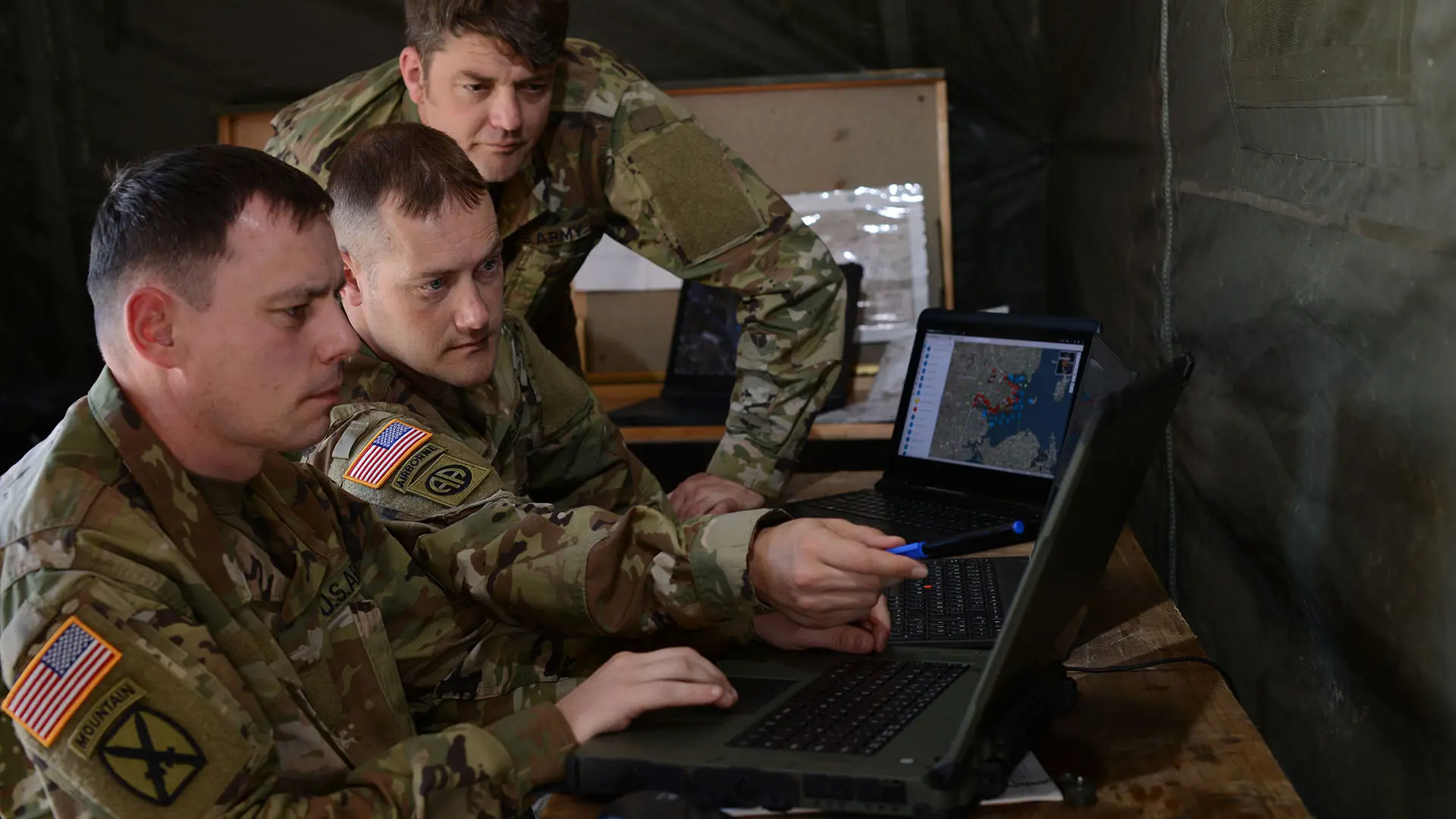
One key requirement sits at the centre of modern interoperability: seamless situational awareness.
This matters on different levels. Delivering the same situational picture for all parties helps to create a fast sensor-to-shooter link, for instance. When it comes to efforts against hybrid operations, such interoperability ensures all parties work from the same data, helping to build an accurate picture of a threat that is often carefully concealed.
But building this shared situational awareness picture is easier said than done. Nations operate a wide array of separate systems with different security levels. The use of different C4ISR systems by various armed forces pose challenges for interoperability across alliance and coalition operations.
What’s more, this international collaboration must grapple with the technical challenges of stove-piped information within national armed forces and the difficulties of building effective communication. For instance, there is a clear need to classify and secure data and communicate across different radios and bearer networks.
Effortless interactions
However, the task of delivering interoperability in C4ISR is not a new challenge and the issues that must be addressed by Finland and the Baltic states are far from unique.
Take Sweden, for example, another new NATO member. Like all members of the alliance, it faces increased demands around interoperability and standard operating procedures (SOPs).
Its C4ISR software has played a key role in smoothing its transition. Like Finland, Latvia and Lithuania, Sweden is an established SitaWare operator; because all these nations are members of the alliance, they can fully integrate their systems through ‘SitaWare-to-SitaWare’ communication and information-sharing, helping to seamlessly exchange information and meet interoperability demands.

However, that’s not to say that interoperability means every nation must deploy the same software. This would be an unrealistic demand and is unnecessary: effective modern systems and software will be designed to communicate and interact effectively with one another.
For instance, take NATO’s Artillery Systems Cooperation Activity (ASCA) standard, which enables multiple firing systems to work together seamlessly. The effectiveness of this approach was demonstrated during Bold Quest 2025, held in Fort Pickett, Virginia, where SitaWare, FC BISA and TAK were able to share situational awareness data through a common interoperability standard. SitaWare’s Fire Support module, for instance, was capable of sending target data directly to FC BISA, which then returned gun target line data.
How C4ISR software can help
Integrated thinking across multiple nations and armed forces – and between different software systems – is essential to monitor and effectively counter the hybrid threat posed by Russia today, not just for Finland and the Baltic states but across Europe.
Perhaps most obviously, it enables intelligence data to be seamlessly shared across a wide variety of sensor systems, ensuring that allied militaries have the clearest possible picture of the hybrid danger at any point in time.
How could this work in practical terms when it comes to addressing hybrid threats? Take the example of attacks on undersea cables, which has clear relevance for Finland and the Baltic nations today.
Cutting-edge C4ISR software tools can help in several ways:
Fuse surveillance data from various sources into a single recognised picture, with AI-powered anomaly detection automatically flagging suspicious vessel activity near critical undersea infrastructure.
Provide allied navies and coastguards with a shared, interoperable common operating picture, enabling the nearest capable unit to be tasked to investigate or respond regardless of which nation owns the assets.
Correlate vast volumes of historical track data, vessel behaviour, and environmental conditions using AI-driven analysis to uncover patterns that support attribution and build an evidence base for diplomatic or legal action.
Reducing the cognitive overload
The sheer range of data sources available today can help commanders and personnel to make better-informed decisions, empowering their efforts to counter hybrid pressure.
However, it can pose challenges of its own.
However, autonomy and AI can help. This point was raised in the Military Intelligence Review 2026 from the Finnish Defence Forces; in his foreword, Defence Command Chief of Intelligence Major General Pekka Turunen noted:
“The speed of information processing, finding essential information and the speed of analysis have become vital in order to achieve an understanding of the situation faster,” he wrote. “In the future, the flood of information cannot be managed without extensively utilising artificial intelligence in the field of military intelligence.”
This is already having a significant impact in the maritime domain. For example, AI-powered anomaly detection can identify unusual vessel behaviour in AIS data, such as unexpected course changes, loitering near critical infrastructure, or suspicious gaps in transmission.
In the context of hybrid threats, this could help operators detect potential sabotage activity near undersea cables or pipelines before damage occurs.
While it seems certain that data will only grow in volume on the battlespace, it is also clear that technology will enable operators to exploit this vital resource effectively.
Meeting the future threat
Much has changed in the Baltic region and for Finland since Russia’s full-scale invasion of Ukraine, particularly when it comes to the acceleration of hybrid warfare. Whether it’s GPS denial, border incursions or disinformation, the challenge is complex – and it will only intensify in the coming years.
However, technology provides clear solutions: Faster and more integrated military thinking is no longer optional: it is essential.
To learn more about how Systematic can support military customers in their C4ISR and interoperability needs, contact us today.
Newsletter
Cannot see the form?
Your privacy or security settings may be blocking the form.
Explore more blog posts
 Agentic AI: Opportunities and challenges in a changing battlespaceHenrik Sommer on why agentic AI is a force multiplier and why those who ignore it will be left behindRead more
 The interoperability problem: Michael Holm on why allied forces still can't talk to each otherAn excerpt from Michael Holm's appearance on the Command and Control PodcastRead more
 Why integrated Air C2 is critical to unlocking NATO’s Multi-Domain ambitionSystematic's Mads Würtz shares his take on Air Command & Control acting as real enabler of Multi-Domain Operations in coalition contexts. When the recognised air picture and air planning processes are disconnected from land manoeuvre, maritime operations, or ground-based air defence, friction emerges exactly where speed is most critical.Read more
 The future of C2: Lessons from Ukraine, the push for speed, and the case for sovereigntyAn excerpt from Michael Holm's appearance on the Command and Control PodcastRead more
 C2 for deterrence?Deterrence does not demand a separate command-and-control system, but rather a more credible, integrated, and wartime-ready form of C2 capable of spanning multiple domainsRead more
 Command and Control transformation in the Middle EastAcross the Middle East, the transformation we’re witnessing mirrors global trends: integrated networks, data-driven decision-making, AI, and joint interoperability are no longer optional — they are imperative.Read more
 Frankenstein, JADC2, and the future of warfighting acquisition: An industry perspectiveWithout disciplined architecture and unified standards, the future of command‑and‑control risks becoming a Frankenstein of mismatched systems rather than a coherent warfighting capability.Read more
 Technical interoperability in contested environments is a mustThe U.S. Navy must prioritize both seamless interoperability with allies and resilience in contested communications to ensure credible combat power at seaRead more