
By Vicky Morley, Senior Clinical Advisor at Systematic
Every day, NHS workers arrive at some of the world's most advanced hospitals, equipped with cutting-edge technology and clinical best practice. Yet within hours, many will feel they're failing—not because they lack skill or dedication, but because the system itself makes good care harder to deliver than it should be.
When fewer than half of frontline staff say they can meet all the competing demands of their job, perhaps it's time to ask: is this a people problem, or a design problem?
Around 460,000 NHS staff begin their shifts already exhausted. The financial toll is staggering: stress, anxiety, and burnout cost the health service an estimated £4 billion annually in sickness absence alone, rising to £12 billion when factoring in presenteeism and agency staffing.
Behind these numbers are people doing their best in environments that too often create obstacles to the care patients deserve and staff want to provide. If we are to protect the people who hold the NHS together, we need to look beyond individual resilience and recognise burnout for what it truly is: a systems failure demanding systemic repair.
Burnout as a systems failure
Safe, compassionate care depends on a workforce functioning at its best. Yet persistent misalignment between workload and capacity steadily erodes even the most dedicated professionals.
The World Health Organization defines burnout as "a syndrome resulting from chronic workplace stress that has not been successfully managed." It manifests as exhaustion, detachment, and diminished accomplishment—not as a flaw in individuals, but as evidence of environments that have exceeded their sustainable limits.
The consequences reach far beyond wellbeing. Burnout undermines care quality, increases error and accelerates turnover. When depletion becomes the norm rather than the exception, the very foundations of safe, effective care begin to fracture.
the system is failing the nurse.”

Understanding how systems create burnout
Consider a nurse in a busy emergency department trying to transfer a patient to an inpatient ward. What should be a straightforward handover quickly becomes a web of coordination challenges.
Finding an available bed means calling bed managers or wards directly, because real-time visibility of capacity across the hospital is limited. Arranging patient transport requires another call—and it's rarely clear how many requests are already in the queue or when someone will be available. The equipment needed for the move isn't where it should be, so the nurse starts searching.
All the while, relatives are waiting for updates. A doctor needs assistance. Other patients need care. The phone at the nurses' station keeps ringing. And the nurse is trying to ensure every detail about this patient is documented—knowing that missing something in the handover could compromise care.
Individually, none of these tasks are inherently complex. Together, they compound into a constant sense of pressure and delay. The patient waits. Flow stalls. And before the shift is halfway through, the nurse feels like they're already behind.
This is where burnout lives—not in any single overwhelming challenge, but in the accumulation of friction that prevents good people from doing good work. The nurse isn't failing the system; the system is failing the nurse.

Recognise these challenges?
Columna Flow is built to solve them. The suite optimises hospital workflows across disciplines and departments, with solutions tailored to different staff roles and workflows.
The interface is user-friendly which makes it easy for caregivers, porters and service staff to gain an overview of, pick, and complete planned tasks. Because information is shared in real-time across platforms, coordinators and management can monitor progress and intervene before a potential challenge becomes a real problem.
The systems model
The US National Academy of Medicine's systems model helps us understand how this happens. Rather than viewing burnout through the narrow lens of individual endurance, the model maps how pressures interact across three interdependent levels:
External environment: Policy, regulation, and societal expectations that shape the tempo and constraints of care
Healthcare organisation: Leadership decisions, cultural priorities, and workforce design that either buffer or amplify external pressures
Frontline care: The daily reality of workflows, teamwork, technology, and task coordination where every upstream decision is felt
Each layer shapes the next. Policy influences culture. Culture shapes practice. Frontline strain reverberates back through the organisation, eroding trust and driving attrition. Without intervention, this feedback loop becomes self-reinforcing—and self-destructive.
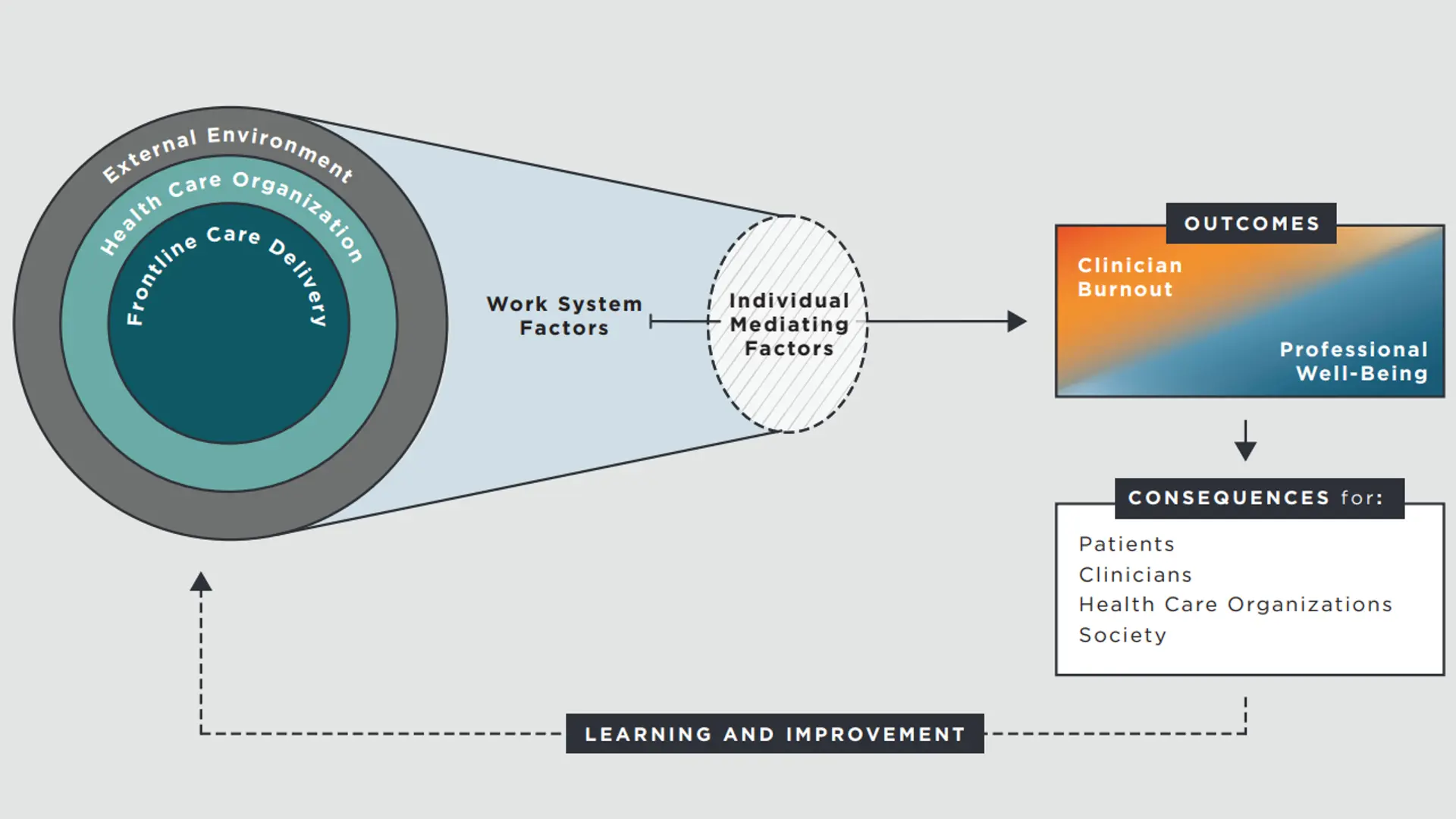
At the model's core sits a deceptively simple equation: burnout arises when job demands consistently outweigh job resources—what the model calls work system factors.
Job demands include excessive workload, long shifts, administrative burden, frequent interruptions, staffing shortages, and poorly designed technology.
Job resources include autonomy, flexibility, supportive leadership, recognition, and meaningful work.
When demands continually exceed resources—when work consistently takes more than the system restores—exhaustion replaces energy and purpose gives way to detachment.
Because these forces operate simultaneously across all three levels, their effects intensify. Even the most resilient clinicians cannot indefinitely offset a structurally imbalanced environment.
The model recognises that individual mediating factors such as personality traits, coping strategies, and support networks influence how people experience workplace pressures. But these personal resources cannot compensate for systemic dysfunction. This is why wellbeing initiatives alone cannot solve burnout. Mindfulness sessions and resilience workshops may mediate symptoms, but without structural reform they risk suggesting that clinicians—rather than conditions—need fixing.
The external environment: When protection becomes burden
Let's examine each level of the model in turn, starting with the external environment where well-intentioned policies often arrive wrapped in administrative weight. Our ED nurse experiences this daily: accessing and recording information across multiple systems, completing mandatory training modules during shifts, following protocols that require additional handoffs and approvals. The impact is substantial—nurses lose more than a quarter of their time to documentation instead of direct care. Their medical colleagues face similar burdens, with NHS doctors spending nearly half their working hours on paperwork. When administrative requirements consume this much clinical capacity, protection has become burden.
Regulation matters. Documentation matters. But we need to ask whether our current approach is accidentally undermining the outcomes it seeks to protect.
A systems approach offers a different path. Shifting regulation from rigid compliance models toward shared governance can protect care quality while preserving the capacity to deliver it. Shared governance fosters ownership, accountability, autonomy, and teamwork—enabling clinicians to help shape supportive care environments rather than merely respond to external demands.

The healthcare organisation: The culture conduit
How organisations respond to external pressures makes all the difference. When leadership values align with clinical purpose, engagement deepens. When they diverge, value dissonance takes hold, quietly eroding purpose and accelerating burnout.
The biggest organisational pressure point is chronic understaffing. The NHS currently faces more than 102,000 vacancies, with nearly a third of staff considering leaving. This creates a vicious cycle of missed care, moral injury, and exhaustion.
Regularly running two nurses down means our nurse isn't just managing their own patient load—they're covering gaps, responding to requests that should go to absent colleagues, and making difficult choices about which tasks to defer. The emotional weight of these trade-offs accumulates: deciding whether to answer a relative's question now or respond to a clinical need first, knowing that whatever they choose, something important waits.
Professionals enter healthcare to help, not to apologise for what cannot be done. Striving to deliver excellent care while structurally constrained reduces motivation and leaves staff depleted. This isn't burnout from working hard; it's the exhaustion that comes from being prevented from working well.
Leaders can recalibrate this balance by investing in psychological safety, fair workload management, and recognition. These aren't "soft" interventions—they're the infrastructure of sustainable care.

The frontline: Where every system tension lands
This is where policy and organisational decisions converge into daily reality. For our nurse, the friction is constant. Digital tools that should streamline work instead multiply it, requiring the same information to be entered in multiple places. Phone calls pile up because there's no shared visibility of who needs what, when. Our nurse can't see the full picture of what's urgent, what's waiting, or where to focus next. Tasks remain invisible until someone physically tracks down the right person. Equipment that should be locatable isn't. Every inefficient process, every poorly integrated system, every communication breakdown compounds the next.
This isn't a deficit of endurance—it's a surplus of friction.
Transforming the frontline means simplifying workflows and aligning technology with clinical logic. When tools serve care rather than obstruct it, both efficiency and professional fulfilment rise. This is design work, not motivation work.
Unlock the benefits of equipment tracking and streamlined workflows
Hospitals across Europe already use Search & Find to cut wasted time and avoid unnecessary costs.
Redesigning the system: From insight to action
Sustainable change begins with recognising that wellbeing isn't a luxury—it's a precondition of effective care. When people are exhausted, even the best frameworks falter. When systems restore capacity and control, purpose returns.
A systems approach reframes leadership around three interlinked priorities:
1. Balancing pressure and permission
At times of severe systemic stress, every small inefficiency amplifies. Leaders can protect staff capacity by consciously designing space: reducing unnecessary meetings, discouraging out-of-hours messaging, and making workload prioritisation transparent.
These aren't minor managerial gestures—they're system-level acts of protection that preserve the cognitive and emotional bandwidth essential for good care.
2. Creating conditions for effectiveness
Staff work best when they have autonomy, clarity, and tools that support rather than hinder performance. This means aligning technology with workflow, embedding flexibility within workload scheduling, and sharing decision-making authority.
Shared governance models demonstrate how collective ownership of improvement reduces frustration and amplifies professional voice. Addressing inequality of experience is also crucial: systems cannot claim to be healthy if some groups consistently bear more strain than others.
3. Reconnecting people with purpose
Burnout isn't only about workload; it's about loss of meaning. Reconnection comes through the everyday disciplines of good leadership—celebrating success, highlighting impact, and communicating objectives clearly and consistently.
Data matters, but so do stories: the moments that remind staff why they chose this profession. Purpose is the most renewable energy in healthcare; it simply needs the right environment to flourish.
These actions align with the National Academy of Medicine's six domains for clinician wellbeing—integrating culture, regulation, organisational design, technology, leadership, and individual agency.
When leaders act across these domains, burnout stops being an inevitable burden.
Toward a system that heals
True transformation means treating burnout as what it is: a design problem demanding design solutions.
Healthcare systems internationally that have applied these principles demonstrate that systems redesign produces measurable improvements in both staff wellbeing and patient outcomes. Those that confront burnout at its roots do more than retain staff. They rekindle purpose and restore the conditions for safe, compassionate care. This happens when systems honour the natural rhythm of human work—clarity, flow, and recovery—allowing both wellbeing and performance to rise together.
The question facing healthcare leadership isn't whether burnout is a problem—the evidence is overwhelming. The question is whether we're willing to redesign the systems that create it.
That means asking uncomfortable questions: Which policies add bureaucratic weight without improving care? Where do our digital systems create work instead of reducing it? When did we last redesign workflows based on how clinicians actually work, rather than how we think they should?
We cannot add staff overnight. We cannot redesign national policy by next week. But we can examine every process, every tool, every meeting, every communication pattern and ask: Does this make it easier or harder for our people to do what they came here to do?
The systems model gives us the diagnostic framework. What's needed now is resolve: to move beyond treating symptoms toward repairing structural causes, to shift from expecting clinicians to be infinitely resilient toward building systems that are inherently sustainable.
The system won't heal itself. But it can be redesigned by people who recognise that burnout isn't inevitable—it's engineered. And what has been engineered can be re-engineered.
Book a free hospital workflow assessment
Uncover opportunities to improve patient flow, enhance staff experience, and strengthen care delivery.
I'll come visit your hospital to identify workflow improvements that enhance patient care and staff experience - completely free of charge and with zero obligation.
Watch the video and hear more about how the assessment works.
References
NHS England (2025) NHS National Staff Survey 2024. https://www.nhsstaffsurveys.com/results/national-results/
The Kings Fund (2025) What does the NHS Staff Survey 2024 really tell us? https://www.kingsfund.org.uk/insight-and-analysis/blogs/nhs-staff-survey-2024-tell-us
NHS England (2025) NHS Sickness Absence Rates. https://digital.nhs.uk/data-and-information/publications/statistical/nhs-sickness-absence-rates
NHS Employers (2024) Mental Wellbeing in the Workplace. https://www.nhsemployers.org/system/files/2024-10/1155.NHSE_Mental_Wellbeing_v3-2024.pdf
WHO (2025) Burn-out an "occupational phenomenon". https://www.who.int/standards/classifications/frequently-asked-questions/burn-out-an-occupational-phenomenon
Hodkinson A, Xhou A, Geraghty K, et al. (2022) Associations of physician burnout with career engagement and quality of patient care: systematic review and meta-analysis. BMJ. 2022;378 https://www.bmj.com/content/378/bmj-2022-070442
The National Academy of Medicine (2019) Taking Action Against Clinician Burnout: A Systems Approach to Professional Well-Being. https://nap.nationalacademies.org/catalog/25521/taking-action-against-clinician-burnout-a-systems-approach-to-professional
Balsdon, H. (2023) How digital can stop nurses drowning in documentation. Nursing Times 119(3):12. https://www.ovid.com/journals/nrtm/abstract/00006203-202303000-00006
McNally S, Huber J. (2021) Developing a 'Doctors' Assistant' role to ease pressure on doctors and improve patient flow in acute NHS hospitals. BMJ Leader 5:62-64. https://bmjleader.bmj.com/content/leader/5/1/62.full.pdf
NHS Digital (2025) NHS Vacancy Statistics England, April 2015-June 2025, Experimental Statistics. https://digital.nhs.uk/data-and-information/publications/statistical/nhs-vacancies-survey/april-2015---june-2025-experimental-statistics