
By Vicky Morley, Senior Clinical Advisor, Systematic. The article was originally published in the online media Health Estate Journal.
As hospitals continue to digitise clinical processes, the promise of faster, safer care increasingly depends on how well digital tools align with day-to-day operations. Vicky Morley, Senior Clinical Advisor at Systematic, explores how fragmented operational systems create hidden friction in hospitals, and how better alignment between digital platforms and frontline operations can streamline care delivery and improve patient flow.
When digital decisions meet physical reality
A clinical decision can be made in minutes. A doctor reviews results, confirms treatment, and agrees that a patient is ready to transfer or discharge. In digital terms, the system works: the decision is recorded in the electronic patient record (EPR), orders are placed, documentation is complete.
But recording a decision is not the same as delivering it.
What follows depends not only on clinical software but on operational infrastructure.
For a patient ready to move, capacity must exist elsewhere in the system. A bed space must be identified and prepared. The room must be cleaned and made safe. The patient must be transported. Equipment must be located and verified as fit for use. Information must move between teams who do not share the same systems, screens or priorities.
These actions determine whether the clinical decision translates into timely care — or into delay.
So why does operational flow still break down inside digitally enabled hospitals?

The issue is not a lack of technology. Most hospitals operate multiple digital systems across operational domains. Bed management platforms, portering and task management tools, maintenance and medical device management systems and asset registers all perform defined functions. The challenge is that they are rarely configured around end-to-end workflow. Instead, they reflect functional ownership rather than the realities of day-to-day operations.
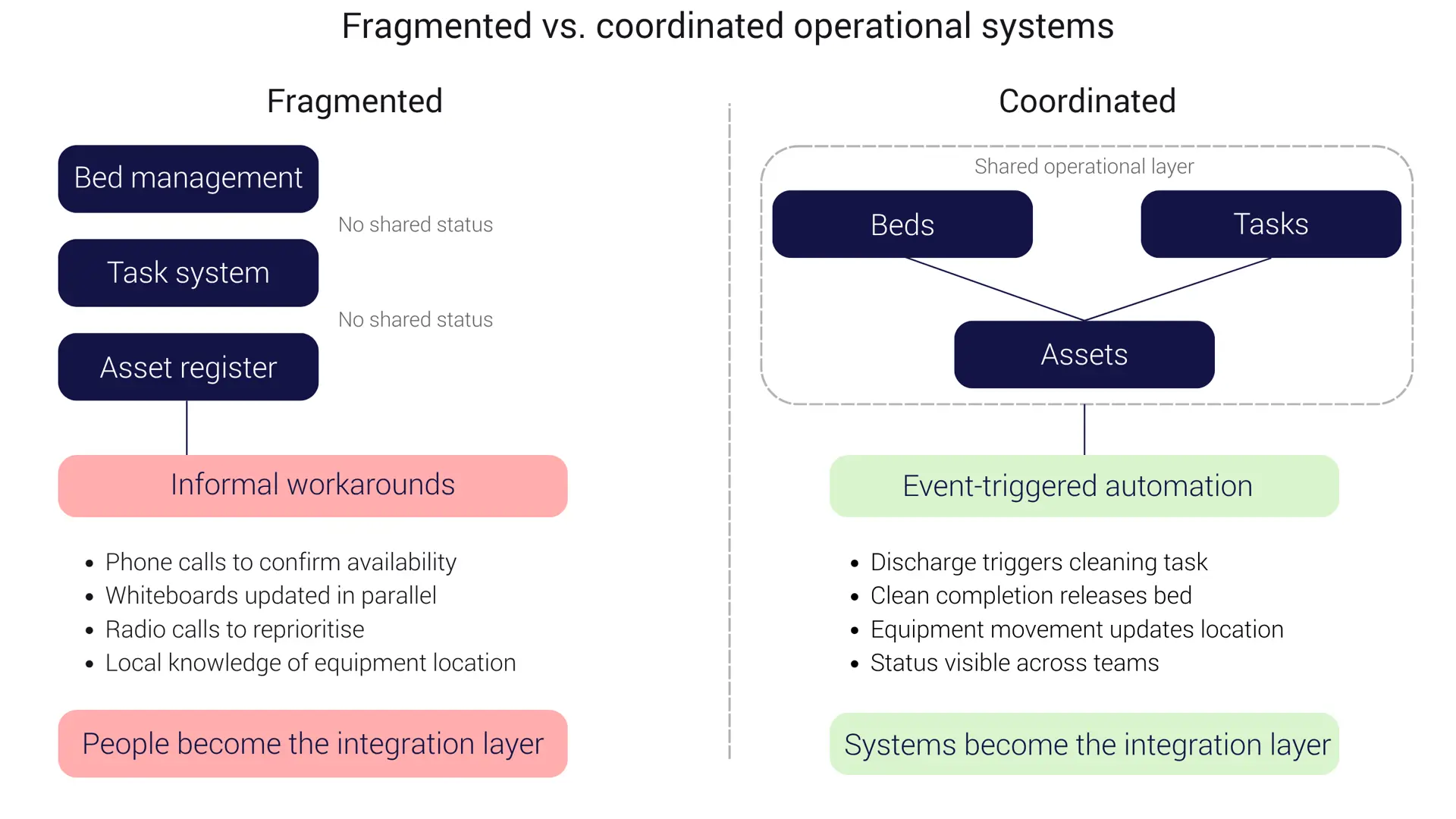
Hospitals therefore rely on informal mechanisms to bridge the gaps: phone calls to confirm bed availability, whiteboards updated in parallel with digital systems, radio calls to reprioritise tasks, local knowledge of where equipment is usually located. These workarounds are not signs of poor practice; they are adaptive strategies developed to maintain flow in complex, high-pressure environments.
The result is a loss of operational coherence between digital intent and physical delivery.
This is the “last mile” of care: the point at which a system's promise meets the reality of delivering it.
If the NHS is to realise the full value of its digital investment, attention must shift to this operational layer. Digitising documentation is only part of the journey. The next step is ensuring that digital decisions translate into care delivered without delay.
Where operational flow breaks down
Coordination challenges tend to arise at the boundaries between systems and teams. Across acute hospitals, three recurring patterns are visible.
Three patterns where flow breaks down:
Digital status lags conditions on the ground
People become the integration layer between systems
Reactive reprioritisation under pressure expands coordination effort
Digital status does not always reflect conditions on the ground
Clinical and operational systems depend on timely status updates. In practice, the pace of clinical work means these updates often lag behind real-world conditions.
A patient may be clinically discharged, but if discharge is not entered promptly in the EPR, the bed remains digitally occupied. This prevents cleaning tasks from being triggered, obscures real-time availability for bed managers and ultimately delays admissions.
Similarly, portering or cleaning tasks may remain open in task management systems even after work has been completed on the ward, leaving operational dashboards out of step with the physical state of the environment.
Asset visibility can present similar challenges. An infusion pump may appear available in an asset register while physically located elsewhere in the hospital. A device may be due for planned preventative maintenance (PPM) yet still be circulating in clinical areas because its status is not visible at the point of use.
When digital records cannot be relied upon as a source of truth, situational awareness is compromised. Decision-making slows, task alignment becomes less predictable, and compliance oversight becomes more difficult to maintain.
People become the integration layer
Where systems do not communicate seamlessly, staff perform the work of integration themselves.
Portering teams may receive digital task requests but reprioritise work through radio communication. Bed managers reconcile occupancy across multiple screens. Domestic supervisors maintain parallel lists to ensure spaces are cleaned in the correct order. Clinical engineering teams rely on ward-level updates to confirm device movement before updating records.
These activities sit outside formal reporting structures, yet they consume significant operational time. They also introduce fragility: coordination depends on individuals rather than shared infrastructure.
Reactive reprioritisation under pressure

Hospital operations are inherently dynamic, yet digital systems tend to assume linear progression: task created, task completed, status updated.
In practice, operational work rarely follows that pattern. Priorities shift and activities are paused, interrupted, escalated or reprioritised as conditions change across the hospital.
When digital tools do not reflect this fluidity, coordination effort expands. Time is lost between decision and action — not because of clinical uncertainty, but because operational sequencing is unclear.
The effects of these three patterns accumulate. Small delays compound across the day. Discrepancies emerge between what systems record and what is physically true. Planned activity is displaced by reactive intervention, and data quality weakens because systems do not align with lived workflow.

The operational cost of fragmentation
This fragmentation has a price. A hospital may be extensively digitised and still lose significant capacity every day to operational friction it cannot easily see or measure.
Operational impact:
Delays in operational coordination reduce effective capacity even where physical space and equipment exist. A bed may be cleaned but not released in the system, a transfer task may not be prioritised at the right moment, or equipment may be unavailable because its location cannot be verified. In each case, patient flow slows and pressure escalates. Across a busy acute site, minutes lost in these handovers accumulate into significant operational strain.
For bed managers and patient flow teams, incomplete visibility of discharge status and room turnaround creates additional uncertainty. Without reliable signals that a bed has been released for use, forecasting availability becomes an exercise in estimation rather than coordination.
In theatre environments, uncertainty around equipment readiness or tray availability can delay list starts or require last-minute substitutions, reducing utilisation of valuable clinical time and disrupting carefully planned schedules.
For estates, facilities and clinical engineering teams, limited asset visibility often pushes work away from planned preventative maintenance toward reactive response. Equipment utilisation falls when location and servicing status cannot be verified with confidence.
The result is a hospital environment that operates with far less predictability than its digital systems might suggest.

Workforce impact:
Senior professionals are drawn into validation and coordination tasks rather than technical delivery. Informal knowledge becomes essential: knowing where equipment is likely to be found, which dashboard reflects the most current status, or who to contact to confirm readiness.
Over time, this increases cognitive load and embeds dependency on individuals rather than systems.
Financial impact:
Extended length of stay constrains elective activity. Theatre downtime reduces productivity. Poor asset visibility contributes to short-term equipment hire or duplicate procurement. Reactive maintenance increases lifecycle expenditure compared to planned intervention.
Individually, these pressures appear marginal. Collectively, they shape capacity, compliance and cost across the organisation.
Why digitisation efforts in operational environments falter
Given the availability of digital tools, why does this gap persist?
The challenge is not simply technical integration. It lies in the nature of operational work itself.
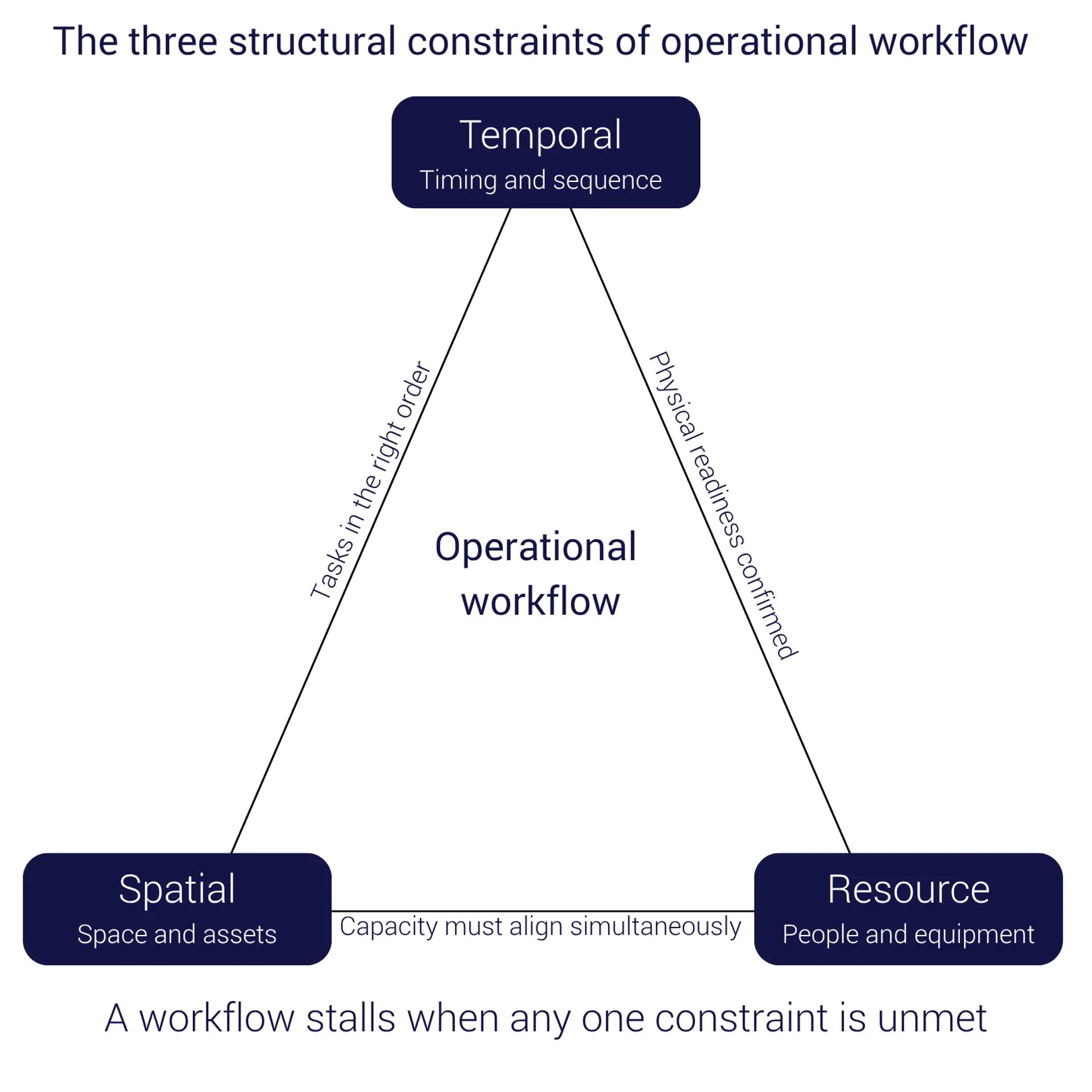
Operational workflows are shaped by three structural constraints:
Temporal coordination - tasks must occur in the right order and at the right time.
Spatial coordination - work depends on the physical readiness of space and assets.
Resource dependency - people, equipment and capacity must align simultaneously.
For example, a discharge decision may be recorded digitally (temporal coordination), but if the bed space has not yet been cleaned (spatial readiness) and transport staff are unavailable to move the patient (resource dependency), the workflow stalls despite the system recording progress.
Digital platforms are frequently implemented using process maps that assume predictable progression and stable conditions. System configuration therefore reflects how work is expected to occur rather than how it adapts under pressure.
In reality, operational routines represent a form of institutional muscle memory. Over years of managing fluctuating demand, spatial constraint and safety risk, teams develop tacit sequencing rules that allow work to continue even when conditions change.
When systems are configured according to expected process rather than lived workflow, friction emerges. If discharge documentation triggers immediate bed reallocation before a space is physically ready, clinical teams may delay updating the system to retain control of sequencing. If equipment tracking relies on scanning protocols that do not reflect real movement pathways, compliance deteriorates during peak demand.
These responses are not resistance to digitisation; they are adaptive safeguards that allow staff to maintain operational continuity.
Systems that fail to incorporate temporal, spatial and resource realities will inevitably be supplemented — or selectively bypassed — by informal coordination mechanisms.
Mapping real workflows before procurement and implementation is therefore essential. Understanding how tasks progress across time, how priorities shift and how information flows between teams provides the foundation for infrastructure that supports delivery rather than constrains it.
Automation as an enabler — when grounded in workflow
Automation, when grounded in operational reality, becomes a structural enabler of flow rather than another layer of operational complexity.
Event-triggered processes can materially reduce manual intervention and strengthen operational visibility. For example, discharge documentation can automatically initiate cleaning tasks, while completion of cleaning can release a bed in real time.
Similarly, tracking the movement of medical devices, theatre trays and other clinical assets can update availability across wards and departments without manual reconciliation.
When workflow has been properly mapped and behavioural incentives support timely status updates, automation reinforces coordination rather than undermines it. It reduces duplication of data entry, shortens the interval between decision and action and limits reliance on informal escalation.
The difference this makes in practice is visible at the ward level. A recent implementation at a large Scottish hospital operating at high occupancy, for example, shows how reducing friction at the point of request can accelerate the entire discharge-to-clean sequence. Nursing staff previously had to walk to a workstation, log in and navigate multiple screens to request a discharge clean — an estimated five minutes per request. By replacing that process with a single mobile interaction at the point of care, the time between discharge and cleaning task initiation reduced significantly. Even modest reductions in that interval compound across the day. Internal modelling suggests that optimising task flows could free up to 12 inpatient beds per day.
The distinction is not between automation and manual practice. It is between automation that reflects operational dependencies and automation that ignores them.
Digitising the last mile of care therefore requires more than connecting systems. It requires designing digital infrastructure around how work actually unfolds so that technology strengthens operational coherence across the hospital.
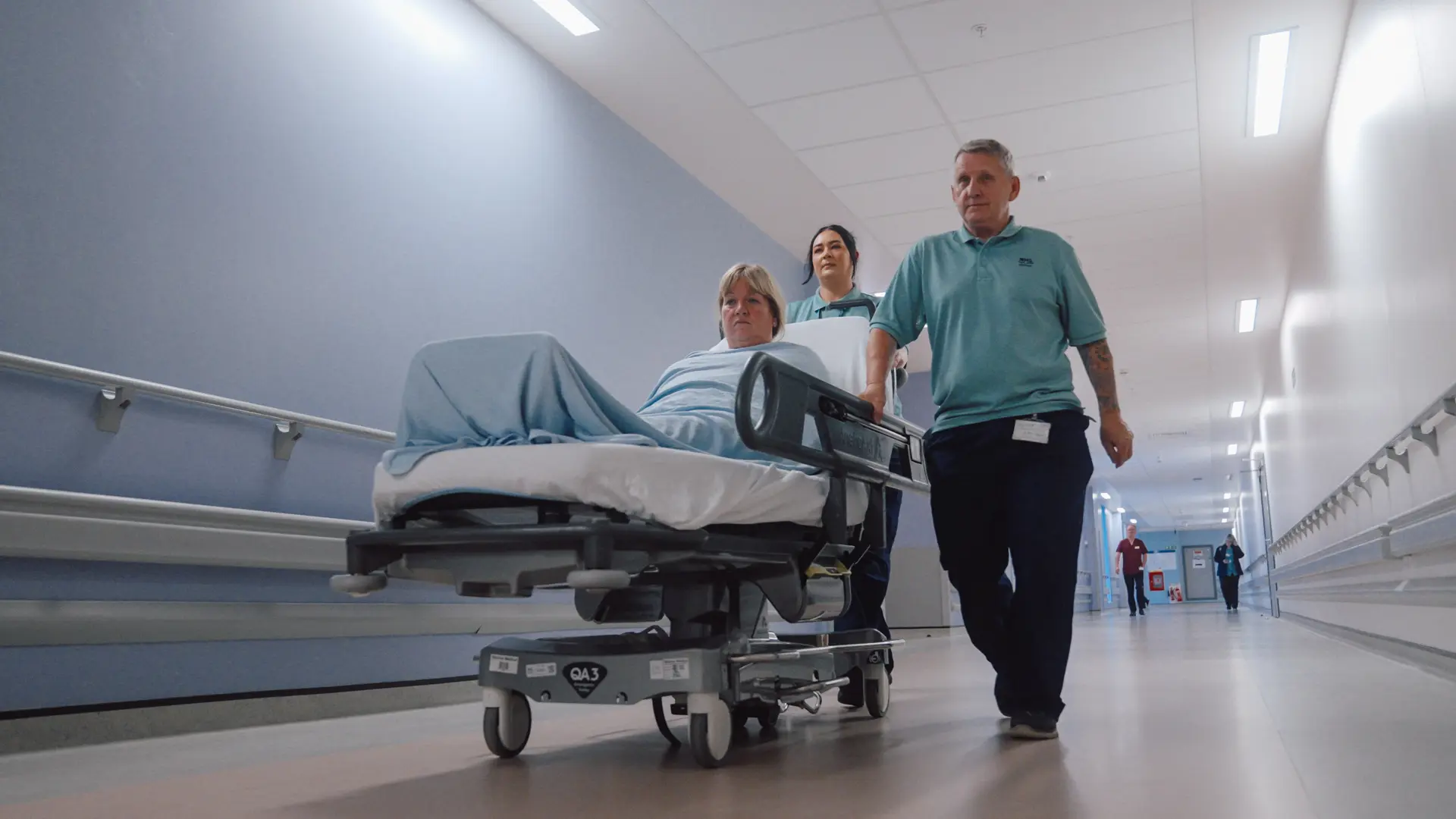
How hospital solution helps porters get patients faster from A to B
Queen Elizabeth Hospital in Glasgow has transformed its porter services with Systematic's Columna Flow Task Management System.
Since implementing the solution in December 2022, the hospital has reduced paperwork, gained real-time operational insights, and achieved measurable improvements in patient care, efficiency, and staff satisfaction.
Engaging infrastructure leaders earlier
A recurring challenge in hospital digitisation programmes is timing. Clinical systems are often prioritised, with operational infrastructure addressed later once architectural decisions have been made and workflow assumptions embedded.
Estates, facilities and clinical engineering teams manage the physical and asset environment that enables care. Their insight into spatial constraints, compliance obligations, asset lifecycles and operational dependencies is critical to system design.
Excluding these perspectives from early procurement decisions risks embedding fragmentation into the digital environment itself.
Reframing the last mile
Digitisation has transformed how clinical decisions are recorded and communicated. The next phase of transformation must ensure those decisions can be delivered reliably within the physical hospital environment.
When digital systems align with real-world workflow, the impact extends beyond efficiency. Hospitals gain clearer operational visibility. They reduce hidden coordination labour. They strengthen compliance and improve flow. Most importantly, they build resilience into the system rather than relying on individual adaptation to hold it together.
Operational infrastructure is not a secondary consideration in hospital digitisation. It determines whether digital investment translates into measurable value.
Addressing this challenge requires earlier and deeper engagement of estates, facilities and clinical engineering leaders in digital strategy. It means designing automation around temporal, spatial and resource realities — and recognising that transformation remains incomplete while digital intent and physical delivery remain misaligned.
The last mile of care is not a clinical problem. It is an infrastructure and coordination challenge — and the operational teams who manage it are not peripheral to hospital digitisation. They are central to its success.

Talk to us about your hospital's workflows
Contact Jacob Gade, Sales Director at Systematic.
With 20 years of experience optimising workflows, Jacob is ready to discuss how Columna Flow can support and optimise your hospital's workflows across disciplines and departments.
Email: jacob.gade@systematic.com
Latest blogs
Thoughtful perspectives on healthcare — what's changing, what's not working, and what we believe needs to happen next. Drawn from our team's work alongside healthcare organisations across markets.
 Healthcare IT is too often left out of the resilience conversationA winter power outage hits several municipalities and lasts for days. The district nurse is still able to take care of residents. Brian Fisker on why downtime robustness belongs in care record procurement.Read more
 What customer success in healthcare IT actually looks likeMost healthcare IT vendors disappear after go-live. We don't. A closer look at how a year of patient transport data and several visits to Hvidovre Hospital reshaped how we think about customer success.Read more
 How we’re bringing AI into CuraAI in healthcare is moving quickly from hype to everyday use. With more older residents, pressure on the workforce, and a growing documentation burden, AI could become one of the concrete tools that frees up time for what matters most: the meeting with the resident.Read more
 We digitised descisions. Now we must digitise delivery.The NHS holds more clinical data than ever, yet patient flow remains a daily struggle. Not because digital transformation has failed – but because we digitised decisions while leaving delivery analogue.Read more
 Finally, the EU is forcing us to share health dataThe European Health Data Space will stand as one of the most sensible EU regulations in years because it solves the fundamental problem of sharing data securely, in a structured way, and across sectors.Read more
 Beyond resilience: How a systems approach is redefining burnoutThe nurse isn't failing the system; the system is failing the nurse. Burnout is a systems failure demanding systemic repair—and it can be redesigned.Read more
 5 data-driven insights to improve NHS trusts equipment trackingIndependent and NHS-backed studies show that poor equipment visibility wastes clinician time and drives unnecessary purchasing.Read more
 Beating BurnoutUnderstanding NHS working conditions, workforce retention and implications for patient careRead more
Latest news
We are happy to share what we do. You can find our latest news here or browse through all of our healthcare news by clicking the button below.
 The digital decisions a new hospital has to make during designA delegation from Manchester University NHS Foundation Trust visited Aalborg's new hospital in September. The lessons were about timing: which digital coordination decisions belong in the design phase.Read more
 What's new in Columna Flow, shaped by the hospitals using itTwo releases since June, one six weeks early. Task overviews open faster, recurring lists stay clean, and planned work now carries a clock icon - several changes because a hospital asked for them.Read more
 Sønderborg Municipality rolls out Cura Dialogue to all residentSønderborg Municipality rolls out Cura Dialogue to all residents, giving citizens and relatives digital access to appointments, messages and care records.Read more
 Capital Region of Denmark launches region-wide hospital trackingHospital tracking data is only useful if it can be shared. The Capital Region of Denmark has gone live with an open platform, built with Lyngsoe Systems, spanning nine of the region's hospitals.Read more
 Eight Greater Copenhagen municipalities extend their Cura partnershipThe Greater Copenhagen Digitalisation Association has awarded Systematic a new six-year contract covering eight municipalities and more than 300,000 residents — confirming Columna Cura as the leading care record solution in Denmark.Read more
 Esbjerg Municipality brings social care and healthcare together in CuraUsing a single system gives staff a clearer overview, better coordination, and joined-up working across the organisation.Read more
 QUMEA joins Columna Flow partner ecosystemQUMEA brings radar-based fall and mobility monitoring – privacy-preserving, no cameras, no wearables – into Columna Flow. The newest technology partner in our open hospital ecosystem.Read more
 What Ukrainian combat medics taught us about Battlefield Health50 medics from the Ukrainian front line visited Systematic feedback on Battlefield Health - a solution we have built to follow wounded soldiers from point of injury to hospital.Read more